

Greetings, Cottage Readers!
It’s good to back with you. As some of you may recall, the last Cottage Reader was written as Diana and I prepared for a trip to Ireland. Many of you offered helpful suggestions for preparatory reading, and I did begin some Colm Toibin and Niall Williams, but then two favorite authors I have written about before in the Cottage Reader released new books and I could not resist their call. So I spent the time I should have spent preparing for our Irish trip in the pages of Ann Patchett and Elizabeth Strout.
Recent Reads
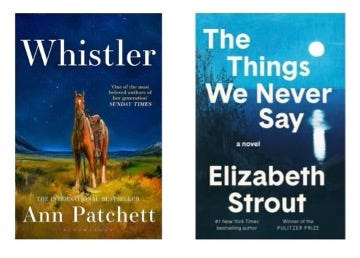
Ann Patchett’s new novel,Whistler, tells the story of a woman who reconnects with her former stepfather, a gay book editor. Years earlier, Daphne and Eddie had been trapped in a car overnight following an accident. Eddie passes the time (and brings a dose of hope) by telling her a story from a book proposal he had received about a woman in a similarly precarious situation who was saved by her horse, Whistler. There’s much more, of course, from the past to the present. It’s a touching book I enjoyed reading.
Elizabeth Strout’s The Things We Never Say leaves behind Lucy Baron and Olive Kitteridge for a new character, Artie Dam, a high school history teacher. Like many of Strout’s books, there is a rich internal monologue that is often at odds with what is happening. These are often illustrated by Strout’s trademark asides:
All of us live with a huge blind spot before our eyes, meaning that no matter what we think we know we can never fully understand how we appear to others. This was true for Artie Dam.
Or:
Mostly we travel through life unsighted, grasping only the smallest details of one another’s selves, including our own. Thinking all the while we can see.
Elizabeth Strout is a wonderful writer, and this is a wonderful book. Read it.
Books after Ireland
As it turns out, I’m not sorry I didn’t do more reading about Ireland before the trip because what I learned there greatly enhanced my experience with two books I’ve read since my return.
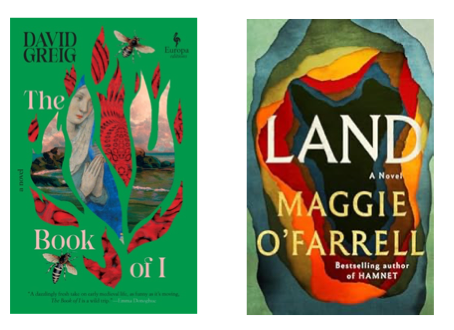
One, The Book of I, a short novel by David Greig, isn’t even set in Ireland, but on the Isle of Iona, well known now a a pilgrimage destination off the coast of Scotland. Set in 825, it tells the story of a Viking attack on the monastery, after which the only survivors are Brother Martin, a young monk (who hid in the latrine to avoid execution), Grimur, a Viking (buried alive after passing out from too much mead), and Una (who makes the mead and tends to the bees). The book tells the story of their lives after the attack—and how they respond to the next one.
Vikings are an important part of Irish history, and attacks like those on Iona were common in Ireland, too. Dublin began as a Viking settlement. The Book of Kells, the treasure on display at Trinity College, Dublin, made a sojourn to Iona to avoid Viking attacks—and then back again for the same reason. So much of Ireland’s history is tied to immigration and emigration, and the Vikings were an important link between the native Irish and the later British occupation.
The Book of I is a charming book (with beheadings). I imagine a number of you have visited Iona (as have I), and this book will increase your appreciation for what you see there. Recommended.
Land, by Maggie O’Farrell, is a remarkable book. It begins in 1865, a few years after the Great Hunger. Tomás, a surveyor, is working with his son, Liam, to create a new map of a peninsula in western Ireland because the landscape has changed so much following the depopulation of the area during the famine. He sends Liam, serving as his chainboy, into a previously unmapped copse in a valley. Liam runs out, terrified. His father goes in, and doesn’t come back out for several days. And when he does, he is changed. He has encountered an ancient well that will become an important character in the book.
We learn about Tomás’s childhood during the Hunger and his time in a workhouse, where he meets the girl who will become his wife, Seraphina. Tomás purchases and moves the family (which also includes two daughters, Enda and Rose, and a nonverbal youngest, Eugene) to a cottage next to the copse. And there they build a life. Tomás resentfully continues to make maps for the “redcoats.” Liam becomes a Jesuit priest and a missionary in India. Enda chafes at rural life, learns to play the fiddle, and eventually emigrates to Canada, as does Rose. As for Eugene, you’ll need to read the book.
So this book has it all: a sacred well, the Great Hunger, Irish emigration, the struggle with imperial occupation, family dynamics, history, romance, betrayal, perseverance, and surrender. At its heart is the land—that flat place between two hillocks, and that island at the western end of Europe.
I have finished Land and Diana is reading it. We will discuss it with the paid community during September. Stay tuned for details. We encourage you to read the book and join us for the discussion.
Maggie O’Farrell also wrote Hamnet, about Shakespeare’s marriage, the death of their son Hamnet and the writing of Hamlet. It’s also a remarkable novel, and the film is great.
I found this inteview with O’Farrell interesting, with background on the book and the Great Hunger. And it’s always nice to hear an author talk about her work.
Upcoming Book Release
In July, Diana interviewed poet Rosemerry Wahtola Trommer as part of the parables series. During the conversation, Rosemerry read some poems from her new book — The Wonderment.
The Wonderment is now available for preorder and will be released in two weeks. Diana loved the book and wrote an endorsement for it. Those of you who are poetry fans will love it, too. Rosemerry’s poetry is beautiful and accessible to all readers who delight in words — even if you don’t consider yourself a poetry fan — pick it up if you have a hankering to see the world more deeply through the eyes of awe and compassion.
Also Recommended
Recently, a “pro shoot” of the stage production of Hadestown was in movie theaters for limited run. My sister recommended it to me, and I’m glad she did. (It’s coming to streaming services soon, so keep your eyes out for it.) I’d heard so many good things about the Broadway production, but I hadn’t seen it. All I knew about the show is that it is based on the myth of Orpheus and Eurydice and that people who saw it absolutely loved it.
It was entrancing. The actors and band are fantastic—I was especially taken by André de Shields as Hermes, who serves as the narrator. The closing number, delivered by Hermes, reminds me of Land.
It’s an old song
It's an old tale from way back when
It's an old song
And that is how it endsIt's a sad song
It's a sad tale
It's a tragedy
But we sing it anyway
'Cause here’s the thing
To know how it ends
And still begin to sing it again
As if it might turn out this time
And that’s the deal with the stories in this month’s Reader. They aren’t happy stories: people die, are dislocated from their homes and homelands and each other, and “travel through life unsighted, grasping only the smallest details of one another’s selves.” I loved them all.
What’s Next?
Almost fifty years ago, as a recent college graduate in New York City, I fell in with a group of people who were reading Anthony Powell’s A Dance to the Music of Time.
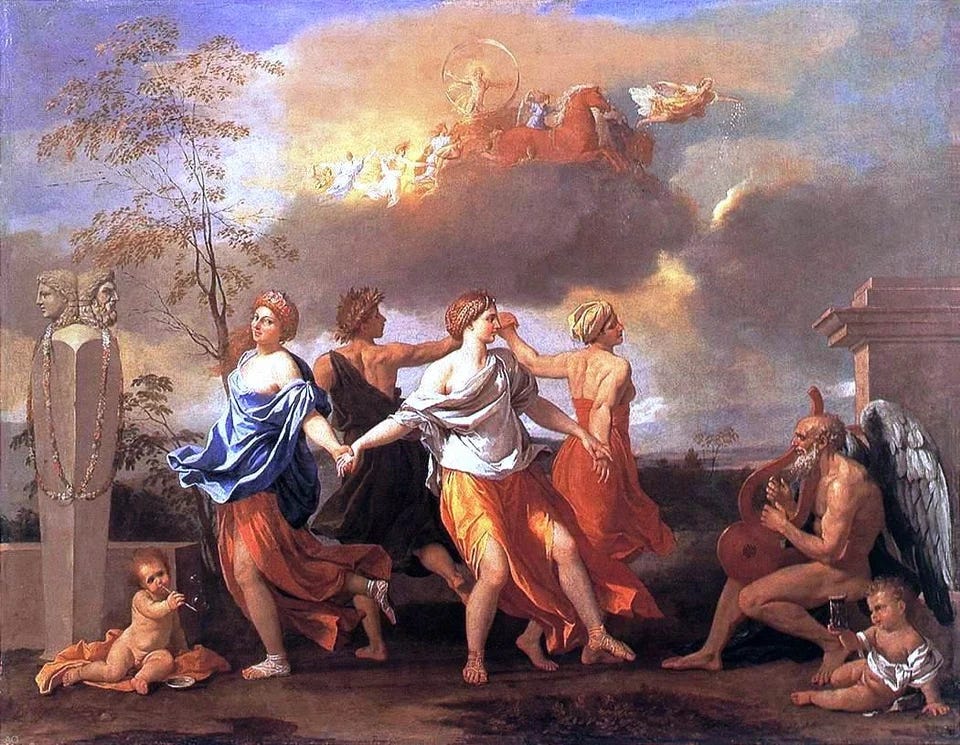
Taking its title from Poussin’s paining (above) it is a twelve-volume work published between 1951 and 1975. So it was completed not long before I began to read it. I devoured it. It remains a benchmark for me, a book I always check to see if a bookstore stocks it (they rarely do, but the wonderful Hodges Figgis in Dublin did carry several volumes).
The narrator of the books is Nicholas Jenkins, whose life closely mirrors Powell’s: Eton and Oxford educated, socially active in between-the wars London, military service during World War II, a literary career, and, always, a close observers of all he encounters. Powell was a contemporary and friend of such figures as Evelyn Waugh, Henry Green, and George Orwell. But that’s just the backdrop. I mainly remember two primary things from the books—the power of coincidence in shaping our lives, and the wonder of Powell’s prose style. A mashup of semicolons, dashes, and colons, subordinate phrase on subordinate phrase. It’s not for everyone, but I loved it.
I’ll be reading one volume a month for the next year. Has anyone else out there read these books?
How About You?
What are you reading? Have I interested you in reading any of these books, or have you read them? I’d love to hear from you, and I’m the rest of the community would as well.
Housekeeping Reminder
We regularly hear from you with questions about your Cottage subscription. How do I change my email address? How do I change my subscription type? Why can’t I access paid content?
We have a Reader Support page that will answer most of your questions. If you still need help, please contact us at the.cottage.email@gmail.com.
It’s a pleasure being in community with you.
Keep reading,
Richard
Richard, I briefly met you at a Southern Lights Conference, and now we are reading buddies. Maggie O'Farrell's LAND transfixed me, as did Hamnet and the film. Elizabeth Strout's new novel, The Things We Never Say, as well as Olive Kitteridge and the rest of her work, is so insightful into the human psyche. I enjoyed Whistler, though it took a bit to get into the depth of the story, and once I was there, I enjoyed the swim.
I recommend The Correspondent by Virginia Evans, Stoner by John Williams, Clear by Carys Davies, and essays: I Am, I Am, I Am: seventeen brushes with death by Maggie O'Farrell. Happy reading.
I read a Dance to the Music of time years ago and loved it. I have never found anyone else who has read it. Thank you for the reviews.